
Get involved!
How great that you’re willing to help us!
On this page, we are asking for your help with various research projects relating to the Frisian language and culture. Just a few minutes of your time can be of enormous help to our researchers.
The surveys listed below have been developed by academic staff at the Fryske Akademy, or have been carried out under their supervision. The results are used in research projects conducted in collaboration with national and international research institutions. All our surveys for which we ask the public to participate have been approved by the Ethics Committee of the University of Groningen/Campus Fryslân.
A contact address is always provided in the calls for participants. If you have any questions about data, privacy or the conduct of the research, you are always welcome to contact the researchers directly.
We currently have four studies for which we could use your help:

The research
As part of this study by the Fryske Akademy, Nanna has drawn up a questionnaire on the credibility of various trivia statements and on how written texts are assessed.
In the first part of this questionnaire, we ask you to listen to 24 statements and determine whether they are true or false. In the second part, you will be asked to read two texts and evaluate them on the basis of a number of questions. Finally, the questionnaire contains a few questions about your (linguistic) background.
Participation in this study is entirely voluntary. You are free to withdraw from the study at any time and for any reason. Anyone who comes from Friesland or lives in Friesland is very welcome to take part!

Practical information
Principal investigator: Nanna Haug Hilton
Position: Senior Researcher and Programme Coordinator Linguistics
Contact: E-mail
Home/on-site: Home
Time commitment:: 15 minuten
Reward yes/no: No
Get involved: Through this questionnaire >>>

Research
Do you have any prejudices about Frisian and Dutch? Really?
Does your brain associate positive things with the Frisian language, or rather with the Dutch language? And what about negative things? Dr Hielke Vriesendorp of the Frisian Academy and Utrecht University is asking 400 Frisian speakers, both within and outside the province of Friesland, and 400 non-Frisian speakers to help investigate this.
Note: Hielke is particularly keen to hear from non-Frisian speakers who live in Friesland!

The research
Hielke has developed an online experiment which, using a sorting task, measures unconscious attitudes towards Frisian and Dutch. Participants are shown images and words that are positive or negative, as well as words in Frisian or Dutch. The link between the images and words reveals whether the brain subconsciously associates Frisian or Dutch more with positive (or, conversely, negative) things, thereby bringing unconscious biases to light.
The experiment takes 10–15 minutes, and at the end of the study, each participant is shown their own results. This allows them to gauge their own unconscious preferences. Hielke hopes to attract as many participants as possible, in order to gain a more comprehensive insight into the prejudices surrounding Frisian and Dutch, both amongst Frisians and Frisian speakers themselves, as well as amongst non-Frisians and non-Frisian speakers.
Practical information
Principal Investigator: Hielke Vriesendorp
Position: Universitêr dosint Ingelske Taalkunde en Undersyksmetoaden, statistyk en taalfariaasje. Earder: taalkundich ûndersiker by de Fryske Akademy
Contact: E-mail
At home/on-site: Thús
Time commitment: 10-15 minuten
Reward yes/no: Nee
Get involved: via this research website >>>
Research
How do Frisians process their languages?
How do Frisians actually use their languages in everyday life? And what does that say about their identity, culture and even the technology of the future? These are the questions that our PhD student Dylan Rose from Canada is currently exploring in a unique study into the Frisian language and society.
Codeswitching
Rose is investigating how Frisian speakers use Frisian and Dutch, and what happens in the brain when they switch between the two languages. This process is also known as code-switching. The research forms part of a larger project that focuses not only on language use, but also on how Frisians experience technology and artificial intelligence. The insights gained may later contribute to the development of technology that is better suited to Frisian society.

The research
For the study, participants are shown images on a laptop. They are asked to name what they see – sometimes in Frisian when they see a Frisian flag, and sometimes in Dutch when a Dutch flag is shown alongside it. Participants wear a headset with a microphone. They also complete a short questionnaire about their language use, their experiences with Frisian and the role the language plays in their identity. “Switching between languages can be quite challenging,” says Rose. “But the participants who have already taken part found it particularly enjoyable.” The study is open to people aged between 18 and 75 who speak both Frisian and Dutch.
Practical information
Principal investigator: Dylan Rose
Position: PhD candidate at the Fryske Akademy and the University of Groningen (RuG)/Campus Fryslân
Contact: via Email
Home/on-site: On-site, in Groningen (Harmoniegebouw) or Leeuwarden (Campus Fryslân)
Time commitment: 45 minutes
Reward yes/no: Yes, €8
Get involved: Book an appointment via Dylan Rose’s appointment calendar
Further information: here on our website
Research
A nose for heritage
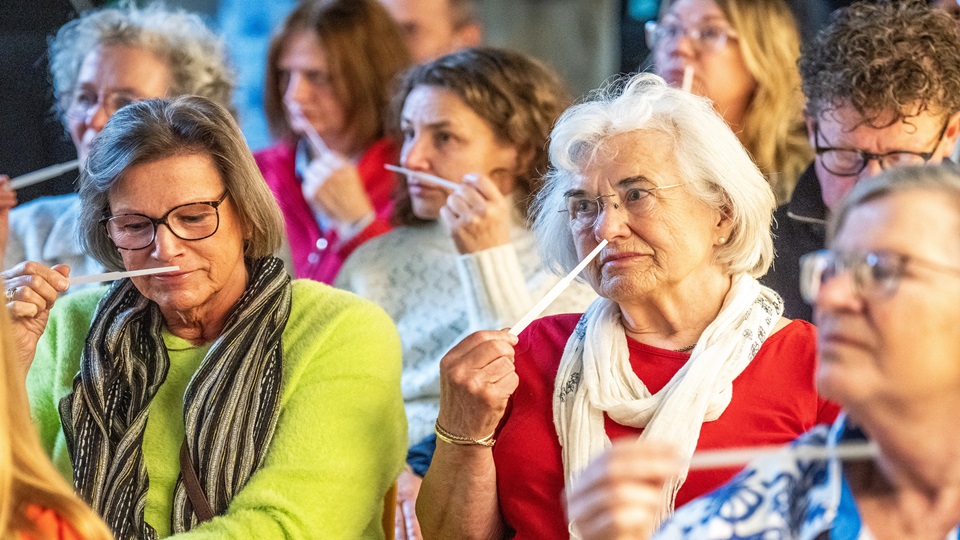
What does Friesland smell like? What is ‘Frisian fragrances heritage’? And: who actually decides which scents are recognised as heritage? In the new research project *A Nose for Heritage*, researchers, designers and perfumers are joining forces to investigate, document and bring the scents of Friesland to the fore.
At the intersection of heritage, scent and design
More and more people are realising how important smells are to our memories, emotions and identity. Yet smell is scarcely visible or tangible in the field of heritage. ‘A Nose for Heritage’ – a collaboration between the KNAW Humanities Cluster (Meertens Institute and NL-Lab), the Fryske Akademy and IFF (International Flavours & Fragrances) – aims to change this by giving scent a rightful place within heritage research, museums and archives. The project, which runs from February 2026 to June 2027, led by Prof. Dr Inger Leemans (Professor of Cultural History and Principal Investigator of NL-Lab at the KNAW Humanities Cluster), is funded by CLICKNL, the knowledge and innovation network for the creative industries.

Why Fryslân?
Friesland presents an interesting contemporary case study, as ‘the smells and sounds of the Frisian countryside’ are set to be included in the Province of Fryslân’s heritage agenda in 2025. This initiative raises fundamental questions: what do we actually mean by ‘the smells of Friesland’? Are they the smells of cowsheds and the Wadden Sea? Or of sugar bread, dúmkes, herbal bitters, evening primroses, the stjonkfabryk, or woodcarving? Dong, smoke from drying hay, smoke from sheep pens, or forest smoke? How can these historical scent landscapes and ever-evaporating scents be captured?
Practical information
So what does Friesland smell like? We can answer that question straight away: you decide. By completing the questionnaire, you’ll help us map out the olfactory language and scents of Friesland. Keep your nose open and share your scent impressions and olfactory discoveries.
Principal investigator: Eveline de Smalen
Position: postdoctoral researcher at NL-Lab/KNAW Humanities Cluster and guest researcher at the Fryske Akademy
Contact: Email
At home/on-site: At home
Time commitment: 15–20 minutes
Reward yes/no: No
Get involved: By completing the Frisian questionnaire or the Dutch questionnaire
Further information: on the project website