
![[Translate to English:] University of Cambridge. Photo: alexxis via Pixabay](/fileadmin/_processed_/8/f/csm_2026_news_cambridge_2db1b8fc28.jpg "[Translate to English:] University of Cambridge. Photo: alexxis via Pixabay")
[Translate to English:] University of Cambridge. Photo: alexxis via Pixabay
Collaboration with University of Cambridge results in postdoctoral fellowship vacancy
International cooperation
The Fryske Akademy and the Department of Anglo-Saxon, Norse and Celtic (ASNC) at the University of Cambridge, with funding from the Frysk Akademy Fûns and the Dennis Green Fund, have established a one-year postdoctoral fellowship (0.8–1.0 FTE), starting in September 2026. We are seeking a postdoctoral researcher who wishes to develop their research in line with the expertise of both institutions.
How did this international collaboration come about? The Fryske Akademy is, of course, a relatively small research institute. We asked Rory Naismith, Professor of Early Medieval English History at the University of Cambridge. “I work in the Department of Anglo-Saxon, Norse and Celtic (ASNC), a small but very active department at the University of Cambridge,” says Naismith. “The research focuses on history, languages, literature and cultures of medieval Britain, Ireland and Scandinavia. It also strongly supports research into contacts with these regions and their neighbours, and scholarship that uses similar methodologies. We therefore sit adjacent to the Fryske Akademy in terms of our area of interest and the approaches we take in scholarship, so a partnership seems a very natural, desirable step.”
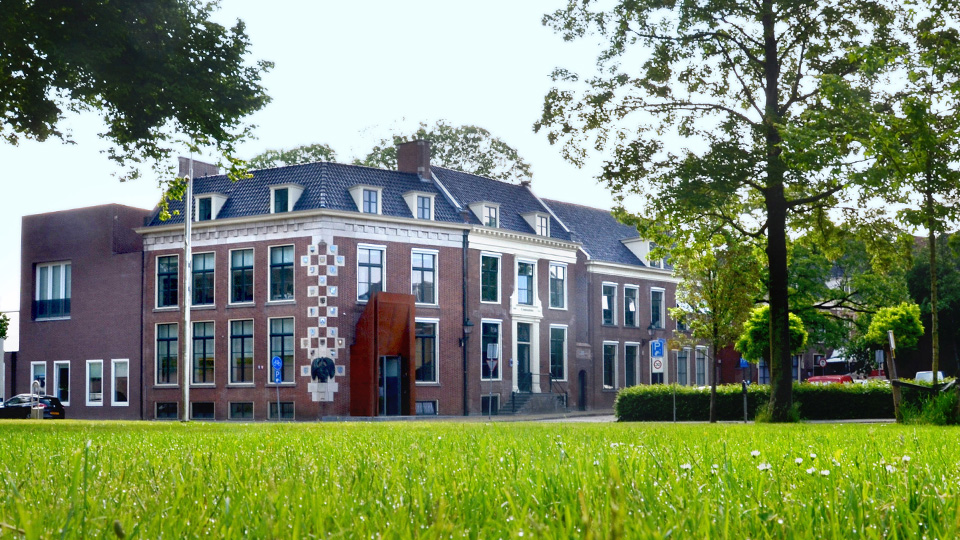
"Cambridge and Leeuwarden are beautiful!"
Staff from both institutions had been collaborating for some time, but the time was now ripe to formalise the relationship by establishing a fellowship. “This reflects our shared desire to respond to the challenging situation in the field,” explains Naismith. “We work at a time when funds and opportunities are scarce, especially for early-career scholars. It is also especially important to foster connections that reach across borders, in order to give researchers the best possible opportunity of working between different academic systems.”
Research into the (early) Middle Ages has been conducted at the Fryske Akademy for some time, such as the research into King Redbad, maritime trade relations and the study of Old Frisian. But how does this fellowship tie in with what ASNC is already doing in the field of research into the North Sea region and the early Middle Ages? Naismith: “ASNC is a dynamic centre of research. Our staff work on a wide range of subjects that range across the North Sea: movements of coin, linguistic and literary influences, travelling scholars, and more. It is a perfect place to work with the Fryske Akademy.”
The vacancy is open until 28 June. Applicants are asked to submit a short research proposal, a cover letter with CV, and an academic reference. The selected candidate will be employed by the Fryske Akademy for one year, and will be able to conduct nine months of research in Leeuwarden and three months in Cambridge. “Both institutions are friendly and pleasant places to work,” Naismith emphasises in conclusion. “And they are situated in beautiful and historic cities!”
